Table Of Content

Be thoughtful about selecting tools that will best support students in meeting your learning goals and outcomes.Read more in Understanding Learning Technologies at Ohio State and Integrating Technology into Your Course. For a deep dive into choosing and using technology for your course, register for the Technology-Enhanced Teaching course. In a standard content-oriented approach to course design, the design process begins by identifying course content.
Stage 1: Identify Desired Results
PlayStation 6: News and Expected Price, Release Date, Specs; and More Rumors - Lifewire
PlayStation 6: News and Expected Price, Release Date, Specs; and More Rumors.
Posted: Wed, 14 Feb 2024 08:00:00 GMT [source]
Think of your plan as a "course skeleton" rather than as a detailed roadmap. Be prepared to review the columns for alignment, move things around, and update your Course Plan as needed as you progress through each step. The following template shows how curriculum is developed, with an eye to “Desired Results” which can be translated to test scores. Join the more than 100,000 creators who use Teachable to share their knowledge.
The Story Behind Travis Scott's Backwards Swooshes - Complex
The Story Behind Travis Scott's Backwards Swooshes.
Posted: Fri, 18 Oct 2019 07:00:00 GMT [source]
Backward design lesson planning – What is it & why you should use it
Scholars in the field of special education, such as Thomas Hehir, question whether the Backward Design framework is flexible enough to accommodate learners with diverse needs. Issues around accessibility, differentiated instruction, and cultural responsiveness come to the fore. This is particularly burdensome for educators who may already be grappling with other responsibilities like grading, classroom management, and ongoing professional development. Even outside the traditional educational environment, Backward Design has its place. By acknowledging these theories and the scholars who contributed to them, we not only appreciate the intellectual roots of Backward Design but also understand its strong academic underpinnings.
The Before, Where the Final Product is a Test
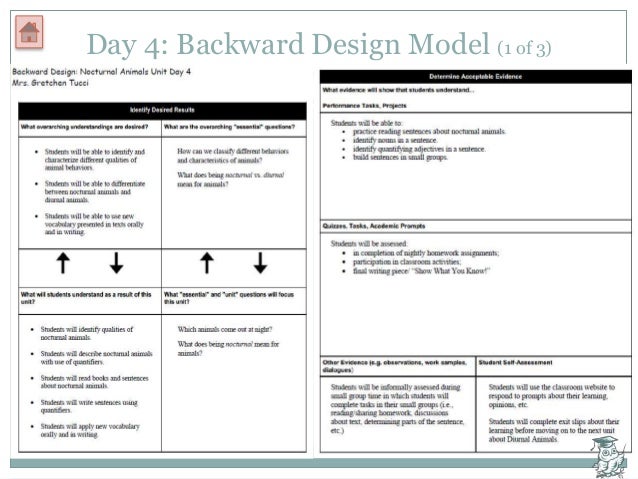
Backward Design’s focus on clear objectives and transparent assessments lets students know what's expected of them, which can enhance their motivation to succeed. Renowned educator Grant Wiggins, one of the creators of Backward Design, emphasized the value of well-defined learning goals in providing direction to both teaching and learning. Identifying the desired results for students by establishing the overall goal/s of the learning sequence/unit using syllabus standards. Focuses on identifying what students will understand, will know and be will be able to do. Educators can follow a simple process to develop backward lesson plans for higher education.
This is most often the case with assessments that are published by corporations whose goal is to maintain a “normal curve” with a few students having high scores, with most students scoring in the middle, and some having low scores. This is in contrast to schools and teachers who want to have as many students as possible attain high scores. Once you figure out your student-focused learning goals, you’ll be better equipped to figure out how best to test for those goals instead of the other way around.
Easily create and sell courses, coaching, and digital downloads with our powerful yet simple no-code platform. Before devoting her work full time to technical writing, she managed—among other intriguing things—to serve as a lead programmer at an Inc. 5,000 experiential branding organization whose clients include Samsung, Time Warner, Netflix, and Sony. A downloadable guide for teaching professionals from the University of San Diego. This psychological theory was developed by Edward L. Deci and Richard M. Ryan in the late 1970s and early 1980s. Self-Determination Theory emphasizes the importance of people feeling in control of their actions, and it posits that this autonomy leads to increased motivation and better outcomes.
Backward design lesson plan
The primary starting point for backward design is to become familiar with the standards/outcomes for the grade level and curriculum being taught. The second part of curriculum planning with backward design is finding appropriate assessments. It can be difficult for "traditional" educators to switch to this model because it is hard to conceptualize an assessment before deciding on lessons and instruction. The idea is that the assessments (formative or summative) should meet the initial goals identified.
These learning goals embody the knowledge and skills instructors want their students to have learned when they leave the course. Once the learning goals have been established, the second stage involves consideration of assessment. The backward design framework suggests that instructors should consider these overarching learning goals and how students will be assessed prior to consideration of how to teach the content. For this reason, backward design is considered a much more intentional approach to course design than traditional methods of design.
The Three Stages of Backward Design
Another benefit of the method is that it brings intentionality to the construction of instructional units (courses, lessons, units). Again, there are numerous strategies for enhancing students’ learning experience, and again, the ones you choose should align well with the goals you’ve defined for the course. For instance, exercises that are active and collaborative allow students to explore new concepts and idea in a relaxed way that encourages them to “own” them.
To gauge effectiveness and find evidence of learning, you’ll need to plan regular mini-assessments throughout the course of a unit or lesson. In a sense, this is “teaching to the test.” But, in a subject with well-defined intended learning outcomes and assessments aligned with them, succeeding at these assessments is the evidence that students have met the subject’s goals. Once you have set a learning objective, how will you determine if students have met the standard?
As early as his 1934 article, “Some Findings from Studies in the Field of College Biology,” Tyler details how he helped faculty sketch out the ideas of needs analysis, backward design, and setting behavioral objectives. In Understanding by Design, Wiggins and McTighe reference Tyler as the originator of behavioral objectives (2005, p. 20). Although backward design has been around for some time (Tyler, 1949), Grant Wiggins and Jay McTighe are often credited with its current prevalence. In Understanding By Design (2005), Wiggins and McTighe explain backward design as a three-stage approach to course planning (p. 17-18). The table below lists these three stages, alongside the tasks and considerations that are central to each stage. In many classrooms, teachers also have students track the appearance of the moon over the course of a month, so that might be added as well.


No comments:
Post a Comment